



Brothers Oleg and Evgenii Smagin, authors of The Korean Dream: A Foreigner’s Guide to Success in the Land of Innovation, share how a decade of studying and working in Korea became a roadmap for the next wave of foreign talent.
When Oleg and Genio first arrived in Korea as students, they weren’t planning to write a book, let alone become guides for the next wave of foreigners trying to build a future here. Over more than a decade, they moved from lecture halls to roles in some of Korea’s leading companies, facing culture shock, workplace hierarchies, and the quiet doubts that come with starting over in a new country. Their new book, The Korean Dream: A Foreigner’s Guide to Success in the Land of Innovation, distils that journey into practical insight for students, young professionals, and experienced hires who see their own future in Korea. In this written interview for The Global Founder, the brothers reflect on the decisions that shaped their careers, the realities behind Korea’s “innovation” story, and the honest advice they wish they had heard before boarding the plane.
The Korean Dream is the guide we wish we had when we first came to Korea.
To begin, could you each briefly introduce yourselves – who you are, what you do, and how your work is connected to Korea today?
We are Oleg and Evgenii Smagin, co-authors of The Korean Dream: A Foreigner’s Guide to Success in the Land of Innovation.
Today, we both work in Korea in roles that bridge global strategy, technology, digital innovation, and Korea-international business relations.
Our careers have centered around market and investment strategy, ecosystem building in finance, AI and gaming fields in such globally recognized companies as SK Telecom, JB Financial Group and WEMADE.
Outside of corporate roles, we co-founded “Digital Twins”, an AI-hosted podcast, and authored the bestselling book “The Korean Dream” about building a successful life and career in Korea as a foreigner.
We frequently speak at tech and investment events, mentor founders, and contribute to academic and industry insights. Our life and work have also been featured on major Korean TV programs across KBS, MBC, JTBC, and XtvN.
We both received an MBA from KAIST College of Business, one of the best universities in Korea and Asia.
What first brought you to Korea, and when was that? How did those first months feel in reality, compared to what you expected before arriving?
We first came to Korea over a decade ago. Even before that, we were fascinated by technology and innovation, and Korea stood out as one of the most advanced and fast-moving countries in the world. While studying in college, we decided to focus our academic work on Korea, which eventually led us here as exchange students.
Those first months felt unforgettable. A mix of excitement, curiosity, and what we can almost call love at first sight. Korea moves fast, its society feels energetic and creative, and when you arrive young, everything feels incredibly stimulating. It’s easy to get swept up in the momentum.
But after the initial “honeymoon period” ended, right after college, we began to see the other side of building a life here as foreigners. That’s when the real challenges appeared: understanding the job market, navigating social codes, and finding our place in a very homogeneous society.
Still, our enthusiasm didn’t fade. Instead, it motivated us to work harder, learn deeply, integrate, and eventually contribute. That transition, from excitement to commitment, became the foundation of everything we’ve built in Korea since.


Over time, you went from students to building careers in leading companies in Korea. Looking back, what were the key turning points that shaped your careers here?
Looking back, our journey in Korea wasn’t shaped by one dramatic moment but by a series of small turning points that accumulated over time.
One of the biggest was committing to the Korean language, not just enough to survive, but enough to belong, to understand nuance, and to build trust. Another turning point came from building networks early, long before we were even thinking about jobs. Those early relationships opened many doors later.
We also made a habit of saying “yes” to opportunities outside our comfort zone – academic competitions, events, internships, anything that helped us understand Korea from the inside. Along the way, we slowly learned how Korean corporate culture works and what it takes to operate effectively in it.
And of course, none of this would have been possible without mentors who took a chance on us early and gave us room to prove ourselves.
None of these moments felt big at the time, but together they compounded, much like long-term investments. Maybe it’s something we picked up from our finance classes, but we’ve always believed in the power of compounding. It’s the same mindset that allowed us to build a life in Korea from scratch and ultimately write this book.
How would you describe the reality of working in Korean organisations as foreigners?Are there specific situations or habits at work that pushed you to grow or adapt in unexpected ways?
Working in Korean companies pushes you to grow in ways you don’t always expect, and the experience has two very different sides.
On one hand, foreigners in corporate Korea are still a relative novelty. In many industries, there simply aren’t many foreign employees, which means you’re expected to adapt fully to a very homogeneous corporate culture.
Expectations around language proficiency and cultural fluency are high, and your performance is often scrutinized more closely because you naturally stand out. Stereotypes can color first impressions, and for many managers, having a foreign team member introduces new dynamics, and sometimes even stress, because it breaks established patterns.
As a result, you may start from a place where you’re slightly underestimated, and the only way to earn your credibility is through consistency, not through statements or self-promotion.
But there is also a very positive and rapidly evolving side. More Korean companies are beginning to see foreign-born talent as essential for global competitiveness. Younger managers especially are much more open to diversity and see it as a strategic strength rather than a complication. As a result, we’re starting to see leaders who delegate responsibility on equal footing, workplaces that genuinely welcome different perspectives, and companies that invest in language support and internal training to help foreign employees feel more included. Many teams now actively value the global insight foreigners bring to the table.
One piece of advice we always share with other foreigners is to pay very close attention to communication and to the subtle signals around you. Korea is a vivid example of a high-context culture, where how you say something often matters just as much as what you say. Strong communication becomes just as crucial as strong performance – sometimes even more.
From what we’ve seen, the people who progress the farthest are not only the top performers, but those who understand cultural cues, read the room well, build relationships intentionally, and communicate with clarity and sensitivity. When you combine that with above-average results, doors begin to open much faster.
Skills open the first door; personality keeps the door open.
Many people wonder if they are the “right type” of person to succeed in Korea. In your experience, what has mattered most for your progress: language, professional expertise, personality, networks, or something else?
All of those matter. The right balance is always the key.
Language helps you understand people and be understood. Korean culture is incredibly contextual, and that context is encoded in the language. Thinking you can build a meaningful career or life here without speaking Korean is simply not the right mindset. You don’t have to be perfect, but without fluency, many doors will remain closed.
Skills earn you respect in a hard-working and highly competitive society. Korea values excellence. When you bring real skills to the table, you show not only what you can do, but how much effort, study, and discipline you’ve invested over the years, and that is deeply respected here.
Personality is the multiplier. Korea appreciates sincerity, humility, and consistency. People here notice how you treat others, how you communicate, how you handle pressure, how you show gratitude. The foreign professionals who succeed long-term are culturally sensitive, reliable, and adaptable. Personality determines whether people want you in the room, whether they trust you, and whether they choose you again. Skills open the first door; personality keeps the door open.
Network is your long-term engine. Korea runs on relationships, not in a transactional sense, but in a trust-based, reputation-driven way. Your network grows when people see your character and work ethic over time. The best opportunities come from introductions, recommendations, and people speaking positively about you when you’re not in the room.
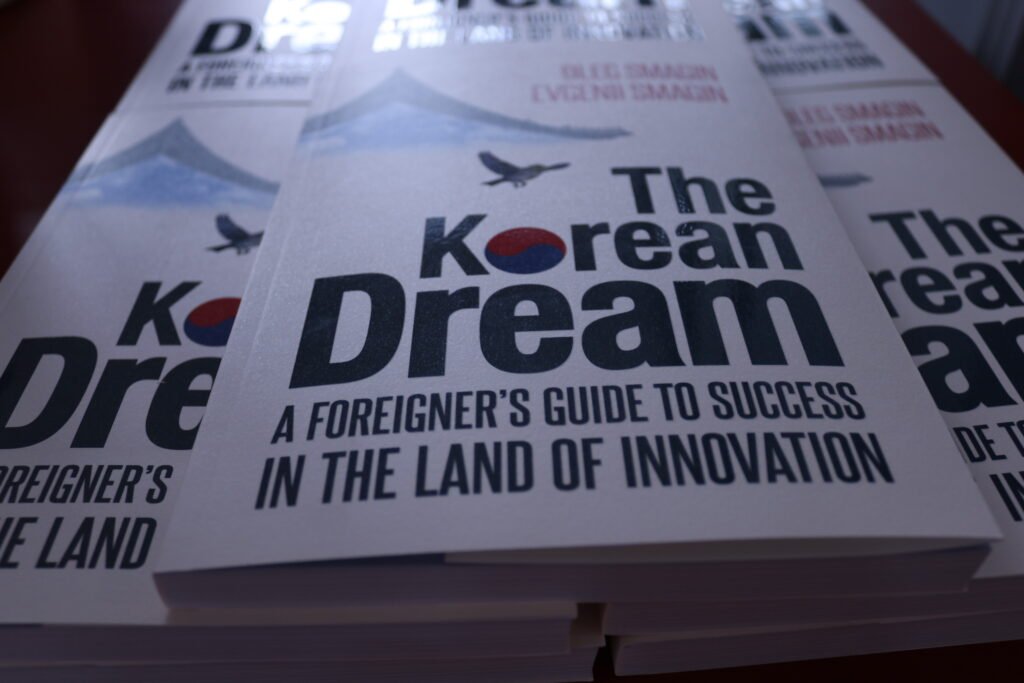
After more than a decade in Korea, you decided to write “The Korean Dream: A Foreigner’s Guide to Success in the Land of Innovation.” What made you feel that this needed to become a book, rather than advice you only share with friends and colleagues?
We kept seeing the same pattern again and again: foreigners arriving in Korea with huge motivation but almost no real guidance on how to unlock their potential in this new environment. After we began sharing our experiences on LinkedIn, our inboxes filled with messages from people we had never met:
“How do I get a job?”
“How do I build relationships?”
“How do I adapt culturally?””
“How do I make Korea my home?
Many of these people eventually became friends, and as we kept replying one by one, we found ourselves asking: “Why keep this knowledge private when so many people clearly need it?”
That’s when the idea of the book was born, not as something for a small circle, but as a guide for thousands of others walking the same path.
For someone who has never heard of the book before, how would you describe it in a couple of sentences? What do you hope readers will take away from it that is not readily available through blogs, social media, or informal guidance?
The Korean Dream is the guide we wish we had when we first came to Korea. The Korean Dream shares our true story of building a life in Korea from the ground up, and shows others how they can follow a similar path. Combining personal stories, cultural understanding, and actionable advice, it’s written for anyone hoping to transform their fascination with Korea into real opportunity.
The book speaks to different types of readers. What do you most want to say to:
a student who is thinking of studying in Korea and staying after graduation: Immerse deeply – language, friendships, experiences. University is the best soft landing a foreigner can have.
an early-career professional considering their first job move to Korea: Expect challenges, be humble, observe carefully, build trust slowly. Your first 12 months define everything.
experienced professionals considering a move to Korea: Your expertise matters, but so does your adaptability. Korea rewards skill, but only when paired with cultural awareness.
Very soon, nearly 3 million foreigners will call Korea home. Millions more dream of traveling, studying, working, or even building a future here. And yet, despite the global fascination with Korea, no book has explained where the real opportunities lie for people who want to contribute, grow, and succeed here, not as visitors, but as future members of Korean society.
No book has captured what it really means to build a life here from zero, climbing every rung of the ladder, facing the unwritten rules, cultural barriers, and invisible systems that only insiders or long-timers understand.
And most importantly: no book has ever told this story from the perspective of foreigners who actually did it. We felt that someone finally needed to put all of this into the spotlight.
So we did.

You describe Korea as “the land of innovation.” From your vantage point inside Korean companies, what does that look like in daily work life? Where do you see this innovative side most clearly, and where is it more of a goal than a current reality?
It’s the speed, the urgency, the obsession with doing things better today than they were done yesterday. In our book The Korean Dream, we talk about how Korea rebuilt itself not by constantly pushing boundaries — and you see the same mindset inside the workplace.
In the book, we describe how Korea’s rise was shaped by a mindset of “solve the problem first, debate later.”Inside companies, this appears as a highly execution-driven culture where teams work intensely to remove obstacles, simplify processes, and deliver results. The bar is high because the expectations are high.
Whether it’s AI, data dashboards, or automation tools, Korean companies integrate new technology extremely quickly.When you work here, you witness how AI assistants, internal platforms, and digital tools become core parts of daily operations, not “future projects” but immediate upgrades.
Foreigners often ask us why performance standards feel so demanding here.
It’s because Korean companies were built by generations who believed that innovation comes from effort, discipline, and collective ambition. In The Korean Dream, we talk about how foreigners entering this environment must bring real skills, real preparation, and a real desire to contribute.
Inside many Korean companies, you feel a shared mission, whether you’re building a mobile game, an AI platform, or a global fashion brand. People want to win together, and they want their company to be the best in the world. That mindset attracts ambitious foreigners and pushes them to grow faster than they expected.
Still, some areas are more aspirational, like decision-making speed or internal hierarchy. but even those are evolving quickly, especially in tech and fintech.
The Korean Dream is absolutely real, but it is earned, not given.
What are some of the uncomfortable truths you felt it was important to include in the book? The things that might not appear in glossy promotion videos, but that people should know before they commit to building a life here?
The first uncomfortable truth is that admiring Korea is not enough. Loving K-culture or being fascinated by Seoul won’t automatically translate into opportunity. This country was built by people who pushed themselves relentlessly, and it expects the same mindset from those who want to join this journey.
Another truth we emphasized is that language is not optional if you want to fully belong. You can navigate daily life without Korean, and you can even get certain jobs. But you cannot access the deeper layers of society – trust, relationships, influence, credibility – without speaking the language.
We also talked about the intensity of Korean work culture. It’s fast, demanding, and often uncomfortably honest. People who come from slower environments may feel overwhelmed. But that speed is exactly why Korea has become a global innovation leader, and learning to move at that pace is one of the biggest growth experiences foreigners go through.
A fourth truth is the emotional side: you have to rebuild yourself from zero. The status you held abroad doesn’t automatically apply here. You start over, proving your value, culture by culture, workplace by workplace. That process can be humbling, and sometimes painful, but it also shapes you into a stronger and more adaptive person.
And finally, we included the truth that the Korean Dream is absolutely real, but it is earned, not given. Korea offers opportunity, but not to those who expect shortcuts or special treatment.
You wrote this book together as brothers, bringing different experiences and viewpoints. How did co-authoring work in practice? Were there chapters or stories where you disagreed, and what did those disagreements reveal?
It was unforgettable, and emotional. We remembered details we had forgotten, compared perspectives, argued (a little), and then pushed each chapter to be better. Our disagreements showed one thing clearly:
Even when you share the same journey, two people experience Korea differently.
That’s why the book feels honest. It combines both of our lenses.
Finally, what would “success” look like for you with this book? For example, individual readers writing to you, universities using it with students, companies giving it to new hires. And what is each of you working on next that readers might want to follow?
For us, success was never just about sales numbers or rankings, even though becoming a #1 bestseller on Korea’s largest platforms is something we’re incredibly grateful for. The real definition of success for The Korean Dream is much deeper.
Success is when someone reads the book and finally understands that their dream of building a life in Korea is possible. It’s when a student tells us the book helped them choose their major with confidence. When a young professional says they no longer feel lost navigating Korean work culture. When a foreigner who has been here for years finally sees a roadmap for growth they never had before. That impact, helping people believe in their path and equipping them to walk it, is the true measure.
Another form of success is the conversation this book creates. Korea is now home to nearly three million foreigners, and for the first time people are openly discussing what that means for society, for companies, for culture, for the future. If The Korean Dream becomes a reference point in that dialogue, a bridge between communities, then it has achieved its mission.
And beyond the book, there’s a bigger vision: to continue exploring the story of foreigners in Korea, their successes, challenges, and the role they will play in the country’s future. Whether through future books, research projects, podcasts, or media, we want to keep contributing to that narrative.
So “what’s next” is simple: more stories, more conversations, and more work to support the people who choose Korea as the place where they want to build their lives. The book opened the door – now we walk through it.
Connect with Oleg and Engenii Smagin
To learn more about Oleg and Genio’s work and to order The Korean Dream: A Foreigner’s Guide to Success in the Land of Innovation, visit the book’s page on Kyobo Bookstore, or connect with them on LinkedIn (Evgenii Smagin and Oleg Smagin).
Interview by Vasiliki Panayi, Founder & Editor-in-Chief of The Global Founder.







Leave a comment