


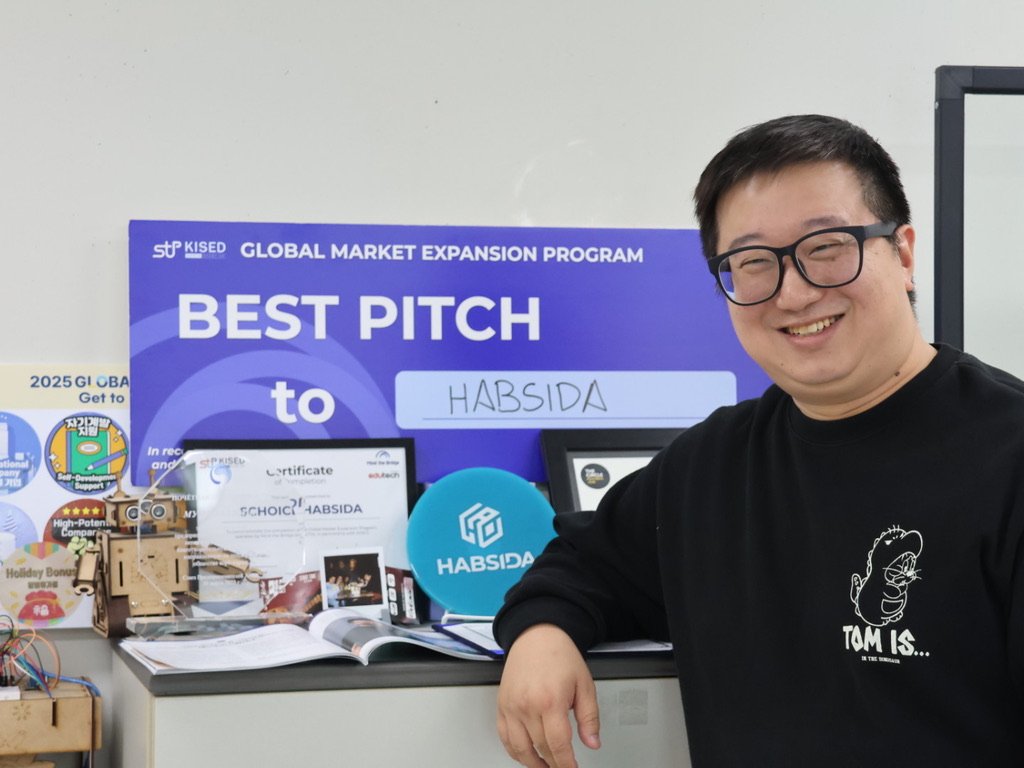
Raised in Russia in a Korean family, founder and CEO Vladi Mun is turning practical coding education into real career paths for foreigners who want to stay and work in Korea.
When Vladi Mun left a growing investment banking career in Saint Petersburg to take a fully funded MBA program in Korea, he expected a one-year detour, not a new life. Eleven years later, he is still in Korea now as the founder and CEO of Habsida, a coding school that helps foreign residents build coding careers in Korea. Having grown up as a Korean in Russia and then arrived in Korea as a “foreigner” himself, Vladi saw firsthand how limited the promise of borderless careers can be. Habsida is his answer: a practical bridge between international talent who want to stay and Korean companies that urgently need developers.
IT is one area where you really can compete with anyone globally. The code is the same everywhere. That became my version of globalization.
You are Korean, but you were raised in Russia, right? That’s two very different worlds. How do you think this multicultural upbringing shaped who you are today?
It gave me a lot of different perspectives. I grew up thinking I was Russian before anyone told me I was Korean. When people at school asked, “Who are you?”, I would say, “I’m Russian,” because all of my friends were Russian and mentality-wise I still feel Russian. I like the culture and I still have many friends there.
But I also look different, so I had to learn how to navigate that. Then when I came to Korea, it was the opposite: I look Korean, but mentality-wise and in some parts of my character I’m different. I had to learn to navigate that world too.
In the end, it shapes who we are. We can’t change it, and for me it’s been a good and fun experience.
What brought you back to Korea, and what inspired you to start Habsida here?
I always tried to be a little bit different. If everybody wanted one toy, I wanted to play with another toy. When I was growing up in the Korean community in Saint Petersburg, everybody wanted to go to Korea. I never wanted to go. I thought, “Okay, Korea, whatever,” and everyone was learning Korean. I wish I had learned it back then, it would have made my life much easier.
One day I got an email from my university saying they had a special program where I could go to Korea for an MBA. I was working in investment banking at the time and building a career, so I thought, why not? I wanted to do an MBA anyway, maybe not at that exact moment, maybe a bit later.
But here was a chance to do an MBA in Korea for free if I applied and got selected. I applied almost for fun, and I got it. I decided to go, thinking I’d go for a while and then come back. That was 11 years ago. I never came back.
When you first started, what did you want Habsida to stand for beyond just teaching tech skills?
Habsida is really a continuation of my own journey. I’ve always been a management major, finance, management, entrepreneurship courses, partnerships in university back in Saint Petersburg. There was always this narrative of globalization: “The world has no barriers, you can work anywhere.”
Then I made a career in investment banking and came to Korea, and suddenly I realized I couldn’t do the same job anymore. The laws are different, the accounting is different, and most importantly, the way people make deals is very different. You need a different kind of network. You need to know the language perfectly, because in high-stakes fields people are very sensitive to mistakes, there’s a lot of risk.
I realized the world is not as global as I thought. It makes sense: a foreign company in a country should struggle a bit, should adapt. I learned a lot from that.
Then I realized there is one area where adaptability is less of an issue and where you really can compete with anyone globally. The work you do in Korea would be the same work you do in Africa, the US, Russia or anywhere else. That area is IT.
You still need local language to communicate with colleagues, but the code itself is the same. That’s when I thought: this will be my version of globalization. This will be my way to bring foreigners into the Korean tech scene. I knew there were many foreign students who went to good universities in Korea, like I did, but struggled to build a career.
If you look at the statistics, somewhere between maybe 5–8% of international students, and some sources even say 0.4%, get a job after graduation. That’s extremely low. At the same time, the government wants to bring more students because of the aging population. What are they going to do after they graduate?
That’s where we come in. We try to help solve that gap. That’s how we started.
Habsida helps foreigners learn tech skills and find jobs in Korea and beyond. Essentially, it helps people ‘find their place.’ Why was that mission important to you personally?
I spent a lot of years in university: four years for a bachelor’s, two for a master’s, four for a PhD, and then two more for an MBA, all in management. And I never really used that education as much as you’d expect.
I saw other people too, at good universities, and if you compare a second-year student to a graduate, sometimes the difference isn’t that big in terms of what they can actually do.
When I started learning IT myself and took courses because I was organizing a coding school, I realized how different that education was from university. There were no lectures, just practice. Nobody helps you directly. They guide you a little bit, but they never answer a question straight. It makes you mad, but you truly learn.
I think that’s very important, especially for things like management. We often teach management in universities with professors who have never really run a business. Then we tell students they are “ready,” and give them cases only top-tier managers will solve – positions they may never reach. What’s the point?
My thinking was: why not take that tuition money and build your own startup? You’ll learn so much over the years by doing, even if you fail. That’s real education.
For me, ideal education is more like med school or pilot school. You don’t graduate and immediately do surgery or fly a plane alone. You’re an intern for years, doing small things, gaining practical experience. That’s how I think education, especially tech and career education, should work.
What cultural or practical challenges did you face creating a company that supports non-Koreans in the Korean job market?
In terms of administration, I personally didn’t face many barriers. I have Korean roots, so I got an overseas Korean visa. With that visa I can stay as long as I want, open any company I want, and work anywhere. It’s a great system from the Korean government.
Even for foreigners without Korean roots, it’s possible to open companies here. The administrative barriers and visa restrictions are not that strict. Setting up a bank account is easy, finding people is not that hard if you have money.
The hard part, as everywhere, is actually making the business work. There’s competition and the market isn’t that big. And I chose probably the smallest possible market at the time: foreigners. Nobody really thought about foreigners as a segment to serve. It sounded too specific.
But now there are about 2.5 million foreigners here, around 5% of the population. By 2040 it might be at least 10%, more than 5 million people. They will be more and more integrated into society.
Now our partners and the investors we talk to – we’re raising now – understand this far better than people did five years ago. Back then it was a lot of “Why foreigners? What’s the problem?” Now they say, “Okay, okay, this makes sense. We’ll need this.”
It was hard, but I’m a bit stubborn. I kept pursuing what I wanted to do.
Koreans don’t have to speak English. We are the ones who need to adapt to how they do business.
How does Habsida balance being a Korean company with serving an international community?
In legal terms, we are a Korean company. We’re not an international company that happens to be based in Korea. We’re a Korean legal entity founded by foreigners.
When we apply for projects, we apply as a Korean company. We pitch in Korean if we have to, although we prefer to pitch in English when there is a chance.
Korea is unique in that it has special programs for companies founded by foreigners, because the country wants to attract them. Of course, many government programs are still aimed at Korean citizens, which makes sense, but there are specific startup programs that help foreign-founded companies start in Korea.
So we are a Korean company founded by foreigners, and so far that hasn’t been a problem.
As a founder with a multicultural background, how has that influenced the way you lead your team and connect with students?
Yes, because I have the same problems they do. I had to switch countries, cultures, and I try to understand my customers. I think that’s the main thing a CEO needs to do: talk to customers and understand them.
At some point, I couldn’t talk to every single student anymore and I felt I was losing that connection. So even now, I still personally speak with every new customer when they buy a course. I explain how to study, how to work with a mentor, what to do step by step.
I want to understand how they feel about their job, what they do now, and why they want to change. Most of them want to change careers, build a real career, and stay in Korea. They don’t always have technical skills yet, but they have the urge to do something and staying in Korea is important to them. Learning to code is their best chance.
We started with the Russian-speaking community – Kazakhstan, Russia, Ukraine, other ex-Soviet countries. Now we’ve had about 250 students from 52 different countries. I want to understand every nationality.
Recently, for example, suddenly we’ve had a wave of Nepalese students. So I talk to them more to understand why they’re here, how they’re different, and how we can provide a better service.
What have you learned about leadership in Korea that you think global entrepreneurs should understand before doing business here?
I know many foreigners, not only entrepreneurs, who complain a lot: “The government did this wrong, that wrong. Korea calls itself global but people don’t speak English.” Koreans don’t have to speak English. We are the ones who need to adapt.
My approach is: of course there should be equality and I might not like some things, but it doesn’t matter. I need to understand the way they do business and adjust to the local reality. I’m not going to change the system, and even if all foreigners came together, we still wouldn’t change it. We’d just create more problems.
So we adapt. For example, look at the way Korean companies hire. They want a clean résumé. They want to check everything carefully. They expect a professional photo, and they do pay attention to it. Is it right or wrong? Maybe it’s wrong. But should my students still do it? Yes, because it increases their chances of getting hired. That’s my goal.
At the same time, I think we should be thankful to Korea for how welcoming it can be. Sometimes we even have more opportunities because we are foreigners.
I’ve been to around 35 countries. Korea is the only one I’ve seen where, for example, if you visit Gyeongbokgung Palace, it can be cheaper for foreigners than for locals. That says something.
Korea is a very homogeneous society and the way Koreans do business is very different. You have to read between the lines. That’s the challenge.
Many founders talk about ‘belonging’. Where do you feel most at home, both personally and professionally?
That’s a hard question. I think entrepreneurs, me included, feel at home where their main business is. My main business is in Korea, so I feel at home here. If we establish something big somewhere else, maybe I’ll feel at home there too.
For me, home is where interesting things are happening, where the challenges and opportunities are. You can take money and move somewhere else, and maybe that makes sense financially, but opportunities are different.
I like visiting many countries, but I hate flying, so I’m always trying to balance those two feelings.
In places like Silicon Valley most developers are foreign-born. In Korea it’s close to zero. If the country wants to stay competitive, foreign developers will have to play a much bigger role.
Habsida’s success stories show real human change. Is there one student story that has stayed with you?
I wouldn’t say we’re “super successful” yet, in my head, it should be way bigger than it is, but we’re getting there. There are many stories I remember.
One of my favorites is a woman from Ukraine who called me about a year after we started. She asked, “Do I need a laptop to be a developer?” I said, “Of course. You don’t have one?” She said no, but she would buy one and come back. Usually when people say that, they never come back.
A couple of months later, she called and said, “I bought a laptop. I’m ready.” We started talking and it turned out she was working as a mermaid in an aquarium, literally doing underwater performances with the fish. They hire synchronized swimmers, but I think she was just a swimmer. She wanted to do something else.
She learned Java with us. When she was about to quit her job, she called me again because her director didn’t understand why she was leaving. They thought it was a scam. She asked me to talk to them and explain. I did, and told them she was going to become a developer.
After a couple of months, she found a job as a developer and worked there, then later found another job. She did well.
Eventually her life changed again, she got married, decided not to continue as a developer, and went back to working in an aquarium because she liked it. But the point is, she proved to herself she could do it. She still has that skill and can always come back to it. Nobody can say she failed.
Another story is a woman from Kazakhstan who worked as a circus acrobat. She came to Korea with her husband, who is also Russian-Korean like me. She studied Java development with us and now works remotely for one of the biggest companies in Kazakhstan.
We’ve also had a Kyrgyzstan national team soccer player who got injured and studied with us, and another circus performer. A lot of our students used to work in factories.
Every story is different, and every time they find a job, I really enjoy it. That gives us motivation to keep going.
What impact do you hope Habsida will have, not just on careers, but on how Korea is seen as a place for global talent?
Right now it’s hard for Korea to attract top global talent. Salaries are not as high as in some other places. Visas are not extremely difficult, but not very easy either. Cost of living is relatively low, but there are warmer or cheaper places with more jobs.
There are jobs here, but not as many, and many foreigners don’t know how to find them. Only recently have there been English-language job websites; before that, there was basically nothing.
So it’s hard to position Korea as a main destination for global top talent. But there are already many foreigners living here who don’t have a proper career. Why not give them opportunities, train them, and hire them?
If you need more technical talent, look at Silicon Valley: more than 66% of developers there are foreign-born. In the US overall, more than 30% of developers are foreign-born. In Korea, I’d guess it’s less than 0.01%.
That’s why I think what we do can have a big impact. Korea wants to build more companies and be competitive globally, which means it needs more technology and more developers. The population is aging, prices are rising, and the economy, like many others, has its challenges.
I believe foreign developers will play a bigger role in the future. What we’re doing now can be a good foundation for that and, hopefully, increase our own validation as a company too.
What’s next for Habsida? How do you see its role in connecting Korea with the world through education and opportunity?
I always have a lot of ideas. After two or three years of running the company, we already tried to expand to India, we moved part of the team there, and it failed miserably. It was too early for us. Honestly, I still think it’s a bit early to move fully into another country, but we keep testing.
We’ve tried the US through different programs. We tried Saudi Arabia. Next, we want to explore Japan. We want to build mockups, test markets, and develop remote working models.
Korean companies usually don’t use remote work for developers. They want people in the office, they want to talk to them, drink coffee or smoke with them. But at the same time, remote work could help them tap into more talent or reduce some costs.
One company has already tried something like this, but I think we have an advantage because we also teach. We can really confirm that our graduates are good developers.
So the next step is to build on that: connect Korean companies with trained foreign developers, locally and remotely, and keep expanding our presence in other countries while staying rooted in Korea.
Connect with Vladi
To learn more about Vladi Mun’s work helping foreign talent build tech careers in Korea through Habsida, visit www.habsida.com or connect with him on LinkedIn.
Interview by Vasiliki Panayi, Founder & Editor-in-Chief of The Global Founder.







Leave a comment